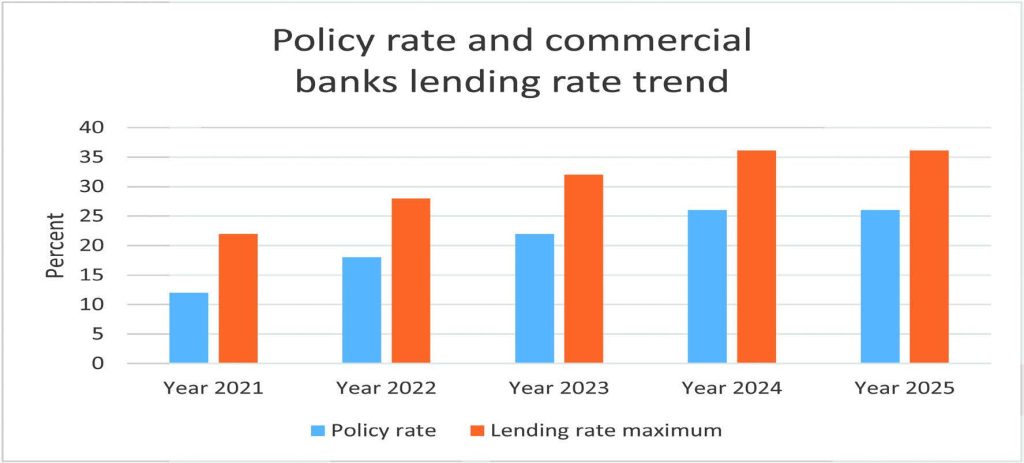
A debate has ensued on the need for commercial banks to lower lending rates from the current 35 percent to enable the real sector access affordable credit in a campaign dubbed ‘Interest Rates Must Fall’.
The reference rate otherwise known as the base lending rate is currently at 25.2 percent, but commercial banks charge interest rates as high as 35 percent, depending on the risk profile of the borrower.
Writing on his Facebook page kick-starting the debate, entrepreneur Hastings Bofomo Nyirenda, who is also chief executive officer of business advisory and auditing firm Grant Thornton, said economic transformation is unattainable if interest rates remain high at above 35 percent, crowding out the private sector.
His analysis attracted several experts, including economists and former banking executives, who gave varying views with some backing the idea, saying there is need for an expansionary monetary policy that drives private sector growth.
In an interview yesterday, Bofomo Nyirenda confirmed his position, stressing that the Reserve Bank of Malawi (RBM) should be the first to adopt a policy stance that facilitates a favourable interest rate regime.
He said: “My point is that because of high interest rates, private sector players are failing to access capital and are closing down, resulting in job cuts and reduced taxes.”
In a separate interview, former banking executive and financial consultant Misheck Esau confirmed to have joined the campaign, saying the economy is in a state of stagnation that requires a fundamental shift to achieve growth.
He said: “We need greater access to cheaper credit for production to happen. We need to produce to be able to export to generate foreign exchange.
“We believe monetary economists have tried every trick in the book to lower inflation but it is not working.”
Esau, a former managing director at CDH Investment Bank, said the entire economy is under high interest rates siege.
“If you ask me, lending rates to productive sectors should be dropped to as low as 15 percent supported by a basket of other measures and incentives to avert certain unintended consequences,” said Esau.
Consumers Association of Malawi executive director John Kapito, in an interview yesterday, said the challenge with the country’s economy is that monetary and fiscal policies do not talk to each other.
In a brief response yesterday, Bankers Association of Malawi president Phillip Madinga said lending rates are determined by monetary policy decisions.
The policy rate has for the past four years risen from 14 percent to 26 percent.
RBM spokesperson Mark Lungu said although it is everyone’s desire to have affordable interest rates for the private sector to thrive, the path of interest rates is dictated by inflation rate.
He said: “In an inflationary environment, implementing an expansionary monetary policy would fuel more inflation and that would hurt the economy further.
“Let us work on bringing inflation down first and that would create an enabling environment for rates to come down.”
The country’s banking sector, which posted K265 billion profit in 2023, is projecting further profit growth in 2024, according to trading statements.